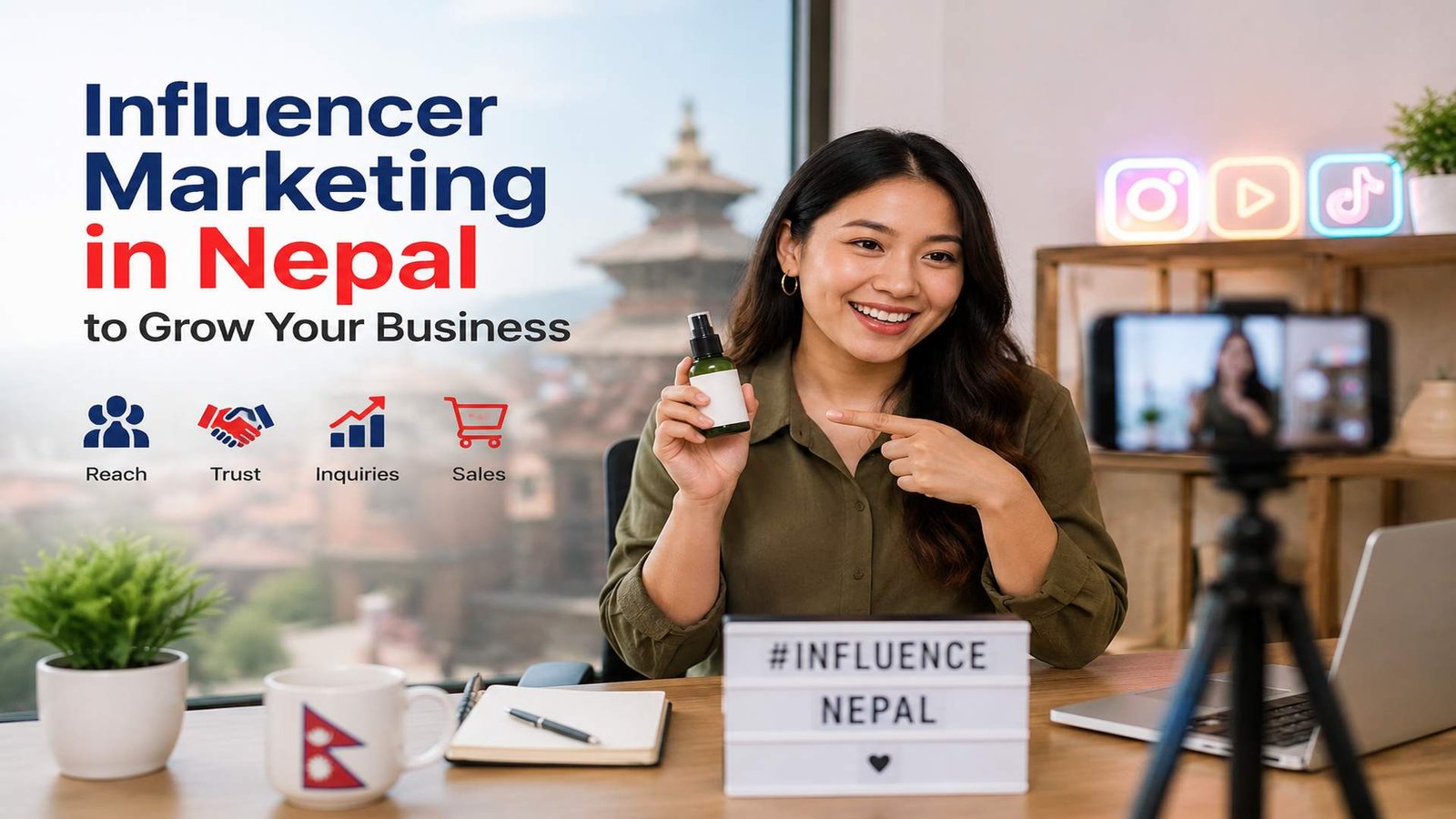
Influencer marketing in Nepal can help businesses grow by turning social media attention into trust, inquiries, bookings, store visits, event registrations, and sales. Nepali customers are now mobile-first, social-first, and trust-driven, so they often discover brands through creators, reels, reviews, and social media recommendations before taking action. The Nepal Multiple Indicator Cluster Survey 2024–25 shows that 82% of households in Nepal have internet access, 85.3% of people aged 15–49 own a mobile phone, and 76.7% own a smartphone. This means many customers are already discovering brands through mobile screens before they visit a store, book a service, register for an event, or send an inquiry.
But influencer marketing is not only about working with popular faces. It works when the right creator speaks to the right audience with the right message and a clear next step. For businesses, the goal should not be only views or likes. The real goal is to turn attention into trust, inquiries, bookings, website visits, event registrations, store visits, or sales.
Influence Nepal helps brands connect with suitable creators based on niche, city, platform, follower range, and audience type. This helps businesses choose influencers with better audience match instead of depending only on follower count.
Why Influencer Marketing Works for Nepali Businesses

Influencer marketing works for Nepali businesses because customers are already using the internet as part of their daily decision-making. The NMICS 2024–25 report shows that 75.1% of Nepal’s population aged 15–49 used the internet in the last three months, and 70% used it at least once a week. This proves that online attention is not limited to young people only. It has become part of normal customer behavior.
For businesses, this creates a big opportunity. A restaurant can show food and ambience through a food creator. A clinic can explain services through a health or skincare creator. An education institute can reach students through youth-focused creators. An event organizer can create excitement through lifestyle, music, or entertainment creators.
Influencer marketing works because it shows the product or service in a real-life situation. A direct ad may say, “We are the best.” But a creator can show the experience, explain the benefit, and make the brand easier to trust.
This is why influencer marketing can support:
- Brand awareness
- Local visibility
- Product launches
- Event promotion
- Website traffic
- WhatsApp inquiries
- Store visits
- Lead generation
- Sales campaigns
The strongest result comes when the creator’s audience matches the brand’s target customer.
How Nepali Customers Trust Creators Before Brands
Nepali customers usually want proof before taking action. They check comments, reviews, videos, page activity, location, offers, and real customer experiences. This is why creator content can feel more trustworthy than a simple brand post.
A creator already has a connection with a specific audience. People follow food creators for restaurant ideas, beauty creators for skincare and salon tips, travel creators for destinations, tech creators for gadgets and apps, and education creators for learning or career guidance.
Trust happens when the promotion feels natural.
Food creators can help cafés reach audiences already interested in dining experiences.
A fitness creator promoting a gym makes sense.
A student creator promoting a course makes sense.
A travel creator promoting a resort makes sense.
But if a creator promotes something far from their usual content, the audience may feel it is only paid promotion. That can reduce trust.
So, the main question is not:
Should You Choose the Influencer with the Largest Following?
The better question is:
Which creator already has the trust of my target customers?
That mindset makes influencer marketing stronger, more honest, and more result-focused.
Which Businesses Should Use Influencer Marketing in Nepal?
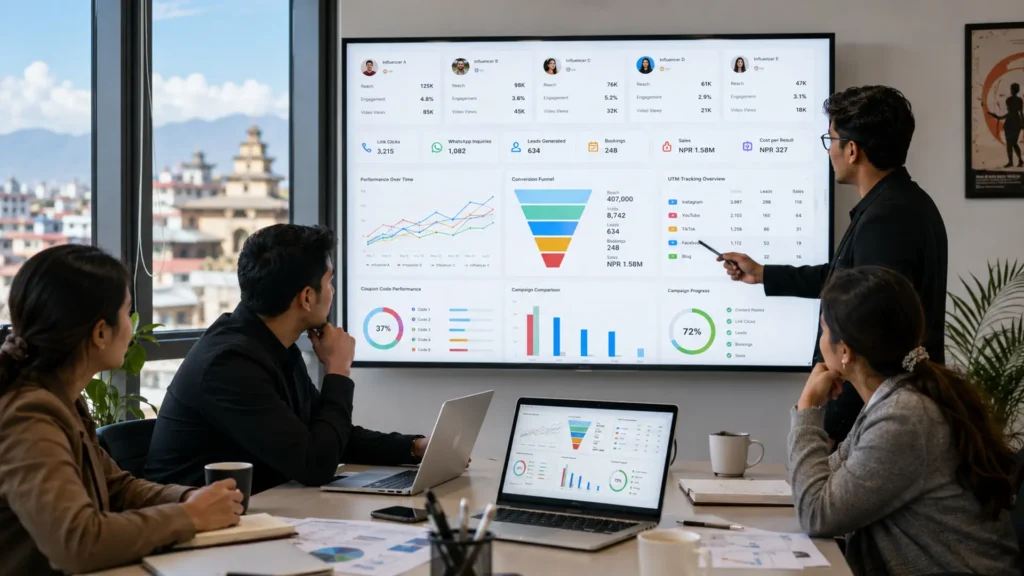
Influencer marketing is useful for Nepali businesses that need visibility, trust, explanation, or customer action. It is especially helpful when customers need to see the product, service, place, result, or experience before deciding.
Restaurants and cafes can use food creators to show dishes, ambience, location, offers, and customer experience.
Beauty salons and clinics can use beauty, skincare, and lifestyle creators to explain services, build trust, and show service quality.
Education consultancies and training institutes can use student-focused creators to explain courses, admission benefits, career value, and learning outcomes.
Event organizers can use lifestyle, entertainment, music, and youth creators to create buzz, promote ticket sales, and increase registrations.
Real estate brands can use lifestyle or property-focused creators to show house features, location value, and buyer confidence.
Travel companies, hotels, and resorts can use travel creators to show destinations, rooms, food, activities, and real experiences.
Ecommerce brands can use creators for product demos, unboxing, reviews, discount codes, and buying instructions.
The strategy should change according to the business. A clinic needs trust. A restaurant needs desire. An event needs urgency. An education brand needs clarity. A real estate brand needs confidence.
That is why influencer marketing should start from the customer, not from the creator.
Micro vs Macro Influencers: Which Delivers Better Results for Your Business?
Micro and macro influencers both can work, but they serve different business goals.
Macro influencers are useful when a brand wants large reach, fast awareness, and wider visibility. They can help with national campaigns, major product launches, big events, and brand recall.
Micro-influencers are useful when a business wants local trust, niche audience, and better engagement quality. For many Nepali businesses, micro-influencers can give better ROI because their audience is often more focused and more connected.
For example, a cafe in Jhamsikhel may get better inquiries from a Lalitpur-based food creator than from a large general influencer. A gym in Kathmandu may get better leads from a fitness creator whose followers are already interested in workouts. A skincare clinic may get better trust from a beauty creator who regularly talks about skin concerns.
Use macro influencers when the goal is:
- Big awareness
- Fast visibility
- Product launch buzz
- Wider reach
- Brand recall
Use micro-influencers when the goal is:
- Local trust
- Niche targeting
- Budget control
- Higher engagement quality
- More serious inquiries
- Community-level influence
For many campaigns, the best option is a mix. One bigger creator can create awareness, while several micro-creators can build trust in smaller audience groups.
How to Choose Influencers by Niche, City, and Audience

To get better campaign results, businesses should choose influencers by niche, city, and audience instead of depending only on follower count. A creator may have many followers, but if those followers are not your target customers, the campaign may bring views without business results.
In Nepal, city and location matter. A Kathmandu-based business should check whether the influencer has a strong Kathmandu audience. A Pokhara hotel should work with creators whose audience is interested in travel and Pokhara. A Lalitpur salon should choose creators whose followers can actually visit the location.
Niche also matters. A creator’s content history should match the brand.
Food creators fit restaurants and cafes.
Beauty creators fit salons, skincare, and clinics.
Travel creators fit hotels, resorts, and tour packages.
Student creators fit education and training brands.
Tech creators fit apps, software, and gadgets.
Lifestyle creators fit fashion, events, fitness, and personal brands.
Before choosing an influencer, check:
- What topics they usually post about
- Where their audience is located
- Whether comments look real
- Whether people ask useful questions
- Whether past sponsored posts felt natural
- Whether their audience matches your customer
- Whether their tone fits your brand
- Whether they can explain your offer clearly
Influence Nepal helps businesses filter creators by niche, city, platform, category, and follower range so brands can make better campaign decisions.
Best Platforms for Influencer Marketing in Nepal
The best platform depends on your target customer and campaign goal. Nepal is strongly mobile-first, so short videos, reels, stories, direct messages, and mobile-friendly landing pages matter a lot.
Facebook is useful for local businesses, community reach, service promotion, event marketing, page engagement, and message-based inquiries. Many Nepali users still use Facebook to discover local offers, events, services, and business pages.
Instagram is useful for visual brands. Beauty, fashion, food, fitness, cafes, travel, lifestyle, and premium services can perform well because Instagram is strong for reels, stories, photos, and creator lifestyle content.
TikTok is useful for fast discovery and short-form awareness. It can work well for food, fashion, beauty, events, ecommerce products, entertainment, and youth-focused campaigns.
YouTube is useful when customers need more explanation. Education, travel, product reviews, gadgets, software, finance, health awareness, and tutorials can work better with long-form creator content.
LinkedIn is useful for B2B campaigns, training programs, consulting, corporate branding, professional services, recruitment, and business events.
A smart campaign does not choose a platform just because it is trending. It chooses the platform based on where the target customer spends time and what type of content helps them decide.
How Much Does Influencer Marketing Cost in Nepal?
Influencer marketing cost in Nepal depends on the creator, niche, platform, content type, campaign duration, and deliverables. There is no single fixed price because every campaign has a different goal.
A story post usually costs less than a reel. A reel costs less than a full review video. A one-time post costs less than a campaign package. A creator with a strong niche audience may charge more than a general creator.
The main cost factors include:
- Follower size
- Engagement quality
- Audience location
- Creator niche
- Content format
- Video quality
- Number of posts
- Number of stories
- Campaign duration
- Usage rights
- Exclusivity
- Paid ad boosting
- Reporting needs
But the cheapest option is not always the best option. A low-cost influencer with the wrong audience can waste your budget. A higher-cost creator with the right audience can bring better inquiries, leads, bookings, or sales.
The better question is not:
“How much does the influencer charge?”
The better question is:
“What business result can this influencer help us achieve?”
This makes influencer marketing more practical and result-focused.
How to Avoid Fake Followers and Low-Quality Engagement
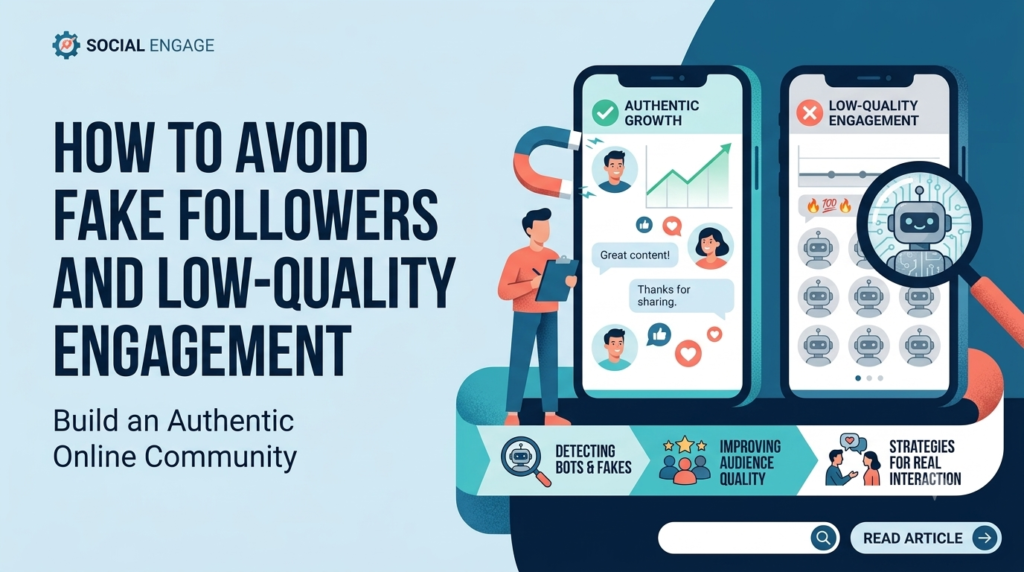
Fake followers are one of the biggest risks in influencer marketing. A profile may look strong from the outside, but the audience may not be useful for your business.
Follower count alone does not prove influence. A business should check engagement quality, comment quality, audience location, content history, and past campaign performance.
Warning signs include:
- High followers but very low comments
- Repeated comments like “nice” or “wow”
- Comments from unrelated locations
- Sudden follower growth without clear reason
- Low story views compared to follower count
- Too many unrelated sponsored posts
- Sponsored posts with no real questions
- Audience that does not match your customer
Good engagement looks different. Real followers ask questions, tag friends, save posts, share content, click links, send messages, and visit pages.
For Nepali businesses, this is very important. If your campaign is for a Kathmandu restaurant, your audience should include people who can visit Kathmandu. If your campaign is for an education institute, the audience should include students or parents. If your campaign is for an event, the audience should include people who can attend.
A proper influencer check should include both data and human review.
How to Plan an Influencer Campaign from Brief to Post
A strong influencer campaign needs a clear plan before the content goes live. Without a proper brief, the creator may post something that looks good but does not support the business goal.
Start by defining the goal. Do you want awareness, leads, sales, event registrations, store visits, bookings, app downloads, or website traffic?
Then define the audience. A campaign for college students is different from a campaign for parents, business owners, beauty customers, travelers, or property buyers.
A good influencer brief should include:
- Brand introduction
- Campaign goal
- Target audience
- Key message
- Product or service details
- Offer details
- Content format
- Posting date
- Location tag
- Hashtags
- CTA
- Tracking link or coupon code
- Do’s and don’ts
The creator should also get creative freedom. If the content sounds too scripted, the audience may skip it. Good influencer content should feel natural while still giving the brand message clearly.
Before posting, check price, date, location, offer, contact number, spelling, claim accuracy, and CTA. This protects the brand, creator, and customer.
How to Turn Influencer Reach into Leads and Sales
Views are useful, but views alone do not grow a business. A campaign can get high reach and still fail if people do not know what to do next.
To turn reach into leads and sales, every influencer post needs a clear CTA.
Good CTAs include:
- Send a WhatsApp message
- Book a consultation
- Call now
- Visit the website
- Register for the event
- Use this discount code
- Visit the store
- Fill out the form
- DM for details
This is important because Nepal’s digital payment behavior is also growing. Nepal Rastra Bank reported 24.65 million mobile banking users and 23.46 million wallet users by mid-July 2024. QR payment transactions also grew by 117.03% in FY 2023/24. This shows that many customers are already comfortable taking digital actions after seeing something online.
So, influencer marketing should connect attention with action. Your website, WhatsApp link, inbox, phone number, booking form, payment process, and sales response must be ready before the campaign starts.
Before launch, check:
- Website speed
- Landing page clarity
- WhatsApp link
- Contact number
- Social media inbox
- Offer details
- Sales response time
- Booking process
- Payment or registration steps
Influencer marketing becomes stronger when creator content, landing pages, paid ads, retargeting, and follow-up work together.
How to Measure Influencer Marketing ROI Properly
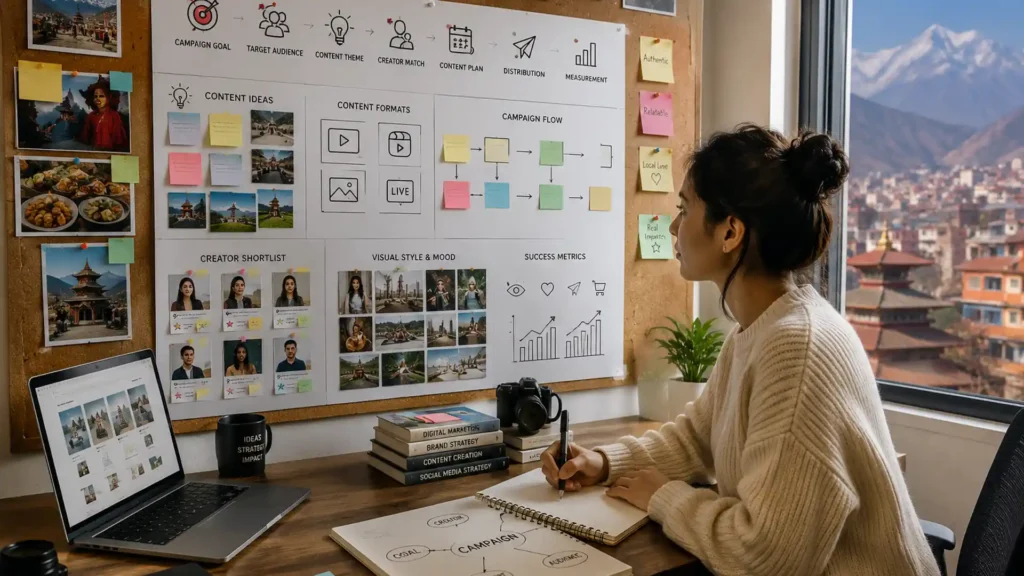
Influencer marketing ROI should not be measured only by likes and views. Likes can show interest, but they do not always show business growth.
The right metric depends on the campaign goal.
If the goal is awareness, track reach, impressions, and video views.
If the goal is engagement, track comments, shares, saves, and profile visits.
If the goal is lead generation, track calls, WhatsApp messages, form submissions, and website clicks.
If the goal is sales, track coupon use, bookings, orders, registrations, and revenue.
Useful ROI metrics include:
- Reach
- Video views
- Engagement rate
- Profile visits
- Website clicks
- WhatsApp messages
- Phone calls
- Form submissions
- Event registrations
- Store visits
- Coupon code use
- Sales inquiries
- Cost per lead
- Cost per sale
Use tracking methods where possible. UTM links, coupon codes, campaign landing pages, QR codes, unique WhatsApp links, and call tracking can help show which creator brought better results.
A strong campaign report should answer:
- Which creator performed best?
- Which platform performed best?
- Which content type worked best?
- How many leads came from the campaign?
- What was the cost per result?
- What should improve next time?
This turns influencer marketing from random posting into a measurable growth channel.
Why Long-Term Creator Partnerships Build More Trust
One-time influencer posts can create quick attention, but long-term creator partnerships can build stronger trust.
Trust grows when people see a brand more than once from a creator they already follow. Repeated exposure makes the brand familiar. Familiarity can support confidence, especially when the product or service needs explanation.
Long-term partnerships work well for:
- Clinics
- Education brands
- Fitness centers
- Real estate companies
- Travel companies
- Beauty services
- Restaurants
- Ecommerce brands
- Lifestyle businesses
For example, a creator can first introduce a brand, then show the experience, then answer common questions, and later share a follow-up post. This feels more natural than one sudden promotional post.
Long-term partnerships also help the creator understand the brand better. Better understanding creates better content. Better content creates stronger audience trust.
The goal is not only to get attention for one day. The goal is to build trust that keeps working.
Why Work with Influence Nepal for Influencer Marketing
Influencer marketing in Nepal can grow your business, but only when the campaign is planned with the right strategy. Random influencer selection can waste a budget. A planned campaign can help your business reach the right people, build trust, and generate real action.
Influence Nepal helps brands connect with suitable creators based on niche, city, platform, category, follower range, and audience type. This helps businesses avoid guesswork and choose influencers who match their actual customers.
As an influencer marketing platform and PR agency in Nepal, Influence Nepal focuses on both visibility and trust. The goal is not only to make your brand seen. The goal is to help the right audience understand your brand, trust your message, and take action.
Influence Nepal can help with:
- Creator discovery
- Influencer shortlisting
- Campaign planning
- Content direction
- Brand messaging
- Platform selection
- Campaign tracking
- Lead-focused CTAs
- Long-term creator partnerships
Whether you want to launch a product, promote an event, increase local inquiries, build brand awareness, improve social proof, or reach a specific customer group, Influence Nepal can help you plan the right influencer marketing campaign.
If your business wants to use influencer marketing in Nepal to grow with better trust, better reach, and better results, Influence Nepal can help you start with the right creators and the right strategy.
FAQs About Influencer Marketing in Nepal
What is influencer marketing in Nepal?
Influencer Marketing in Nepal means working with social media creators to promote a prodyce, service, event , or brand to a relevent Nepali audience.
Does influencer marketing work for small businesses?
Yes. Small businesses can use micro-influencers to reach local, niche, and more engaged audiences with better budget control.
Which platform is best for influencer marketing in Nepal?
Facebook, Instagram, TikTok, YouTube, and LinkedIn can all work. The best platform depends on your customer, offer, and campaign goal.
Is follower count the most important factor?
No. Audience relevance, engagement quality, city, niche, content style, and trust are more important than follower count alone.
How do I avoid fake influencers?
Check comment quality, audience location, story views, engagement pattern, past sponsored posts, and whether followers match your target customers.
How can I measure influencer marketing success?
Track reach, engagement, website clicks, WhatsApp messages, phone calls, form submissions, coupon use, event registrations, leads, and sales.
Can Influence Nepal help my brand find influencers?
Yes. Influence Nepal helps brands connect with suitable creators and plan influencer marketing campaigns based on business goals.