

Building a successful business takes more than offering a great product or service. It begins with a clear brand strategy that defines who you are, what you stand for, and why customers should choose you. According to the Nepal Telecommunications Authority (NTA), Nepal has more than 30 million broadband internet subscriptions, reflecting the country’s continued digital growth. As internet adoption increases, businesses have greater opportunities to reach customers through websites, search engines, and social media.
At Influence Nepal, we’ve worked with startups, educational institutions, hospitality businesses, and growing SMEs across Nepal. Through these projects, we’ve observed a recurring challenge. Many businesses invest in Facebook Ads, Google Ads, and social media marketing before establishing a clear brand strategy. While these efforts often increase visibility,Without a clearly defined brand position, marketing campaigns often attract broad audiences instead of the customers most likely to convert. In our experience, businesses that define their target audience and brand identity before scaling their marketing build stronger customer trust and achieve more consistent results. Whether you’re launching a startup, expanding an established business, or repositioning your brand, this guide will show you how to build a brand strategy step by step, avoid common mistakes, and create a brand that stands out in today’s competitive market.
What Is a Brand Strategy?
A brand strategy is a long-term plan that defines how people see and remember your business. It includes your brand’s purpose, values, positioning, messaging, and customer experience. A strong brand strategy helps your business stand out, build customer trust, and create a consistent brand across every platform. It also provides a clear direction for marketing and supports long-term business growth.
Why Every Business Needs a Strong Brand Strategy

A strong brand strategy helps businesses earn trust before asking customers to buy. According to the Nepal Telecommunications Authority (NTA), broadband internet subscriptions in Nepal now exceed 30 million, reflecting the country’s continued digital growth. As more customers discover businesses online, trust and consistency have become increasingly important. This is supported by global consumer research showing that people are more likely to choose brands they recognize and trust. Through our experience at Influence Nepal, we’ve found that businesses with clear positioning and consistent messaging are better equipped to build customer confidence and generate qualified leads.
Through our experience working with businesses at different stages of growth, we’ve found that marketing often underperforms when brand positioning, messaging, and value proposition aren’t clearly defined. A well-developed brand strategy aligns every marketing effort, improves customer trust, increases conversions, and supports sustainable growth. Many businesses begin with professional brand strategy services before investing heavily in advertising or digital marketing.
Signs Your Business Needs a Brand Strategy
Many businesses invest in websites, advertising, or social media before establishing a clear brand strategy. While these efforts may generate visibility, they often fail to produce consistent results without a strong foundation. If your business faces any of the following challenges, it may be time to develop a brand strategy.
1. Customers Don’t Remember Your Business
If customers struggle to recognize your business or confuse it with competitors, your brand lacks a clear identity. A strong brand strategy creates a memorable position that helps your business stay top of mind.
2. Your Brand Message Is Inconsistent
If your website, social media, and marketing materials communicate different messages, customers may struggle to understand what your business stands for. Consistent messaging strengthens trust and reinforces your brand identity.
3. You’re Competing Only on Price
When price becomes your only advantage, competitors can easily undercut you. A clear brand strategy highlights your unique value, giving customers reasons to choose your business beyond cost.
4. You Don’t Know Who You’re Marketing To
Trying to reach everyone often means connecting with no one. Defining your target audience and buyer personas allows you to create more relevant messaging, improve marketing performance, and attract the right customers.
5. Your Business Looks Similar to Competitors
If customers can’t clearly explain what makes your business different, your positioning needs improvement. A strong brand strategy identifies your unique strengths and helps you stand out in a competitive market.
6. Your Business Is Growing or Changing
Launching a new product, entering a new market, or rebranding without a clear strategy can create confusion. A brand strategy ensures every change strengthens your identity and supports long-term growth.
Key Takeaway: If customers don’t recognize your business, your messaging lacks consistency, or your marketing isn’t delivering results, it’s time to build a clear brand strategy that creates direction, differentiation, and long-term growth.
Key Elements of an Effective Brand Strategy

A successful brand strategy is built on several key elements that work together to create a consistent and memorable brand. Today, customers discover businesses through Google, social media, websites, online reviews, and recommendations before making a purchase. If your brand communicates different messages across these touchpoints, customers may lose trust and choose a competitor instead. That’s why every successful business needs a clear strategy that guides how it communicates, delivers value, and builds lasting relationships. The following elements form the foundation of an effective brand strategy:
- Brand Purpose
- Mission Statement
- Vision Statement
- Core Values
- Target Audience
- Buyer Persona
- Brand Positioning
- Brand Personality
- Brand Voice
- Brand Messaging
- Value Proposition
- Competitive Analysis
- Brand Story
- Visual Identity
- Customer Experience
- Brand Promise
- Brand Guidelines
Together, these elements help businesses build trust, create a strong market position, deliver a consistent customer experience, and support long-term business growth.
How to Build a Brand Strategy Step by Step

Building a successful brand strategy isn’t about creating a logo or choosing brand colors first. It starts with understanding your business, your customers, and the value you bring to the market. Every successful brand follows a strategic process that creates consistency, builds trust, and supports long-term business growth. Whether you’re developing your strategy independently or with the support of professional brand strategy services, following these practical steps will help you build a brand that connects with your audience, differentiates your business, and creates lasting value.
Step 1: Research Your Market
Every effective brand strategy begins with market research. Before making branding decisions, understand your industry, customer expectations, competitors, and emerging trends. This research helps identify market opportunities, reduce assumptions, and make informed strategic decisions.
Focus on:
- Industry trends and market changes
- Customer needs and buying behaviour
- Market gaps and emerging opportunities
Expert Insight: Beyond market reports, review customer feedback on platforms like Google Reviews, Reddit, and industry forums. Real customer experiences often reveal unmet needs that traditional research may overlook.
Step 2: Analyze Your Competitors
Competitor analysis helps you identify opportunities—not businesses to imitate. Evaluate how competitors position themselves, communicate with customers, and deliver value to understand where your brand can differentiate itself.
Evaluate:
- What competitors do well
- Where they fall short
- Customer needs they aren’t meeting
- Opportunities to position your brand differently
Avoid: Copying competitor messaging instead of building a unique brand position.
Step 3: Define Your Target Audience and Buyer Personas
Strong brands speak to a clearly defined audience. Identify your ideal customers by understanding their demographics, goals, challenges, motivations, and buying behaviour. Then create buyer personas based on real research to guide your messaging and marketing decisions.
Ask yourself:
- Who benefits most from your product or service?
- What problems are they trying to solve?
- Where do they spend time online?
- What influences their purchasing decisions?
A useful buyer persona includes customer goals, challenges, motivations, preferred communication channels, and buying behaviour. The better you understand your audience, the easier it becomes to create messaging that builds trust and drives conversions.
Step 4: Develop Your Brand Positioning
Brand positioning defines how customers should perceive your business compared with competitors. It explains what makes your business different and why customers should choose you.
Answer these questions:
- What problem do you solve?
- Who do you serve?
- What makes your solution different?
- Why should customers trust your business?
Expert Insight: Strong positioning focuses on unique value rather than competing on price alone.
Step 5: Create a Strong Value Proposition
Your value proposition clearly explains why customers should choose your business over competitors. It should communicate your unique value in a simple, customer-focused statement.
A strong value proposition should explain:
- The problem you solve
- The value you deliver
- What makes your business different
Avoid: Generic claims like “best quality” or “excellent service” without evidence or specific customer benefits.
Step 6: Build Consistent Brand Messaging and Voice
Your messaging communicates what your business stands for, while your brand voice defines how you communicate it. Every customer interaction—from your website and emails to social media and advertising—should reflect a consistent tone, personality, and value proposition.
Whether your brand is professional, friendly, innovative, or educational, consistency strengthens recognition, reinforces credibility, and creates a better customer experience.
Step 7: Design Your Visual Identity

Once your strategy is clear, create a visual identity that reflects your brand. This includes your logo, color palette, typography, imagery, icons, and overall design style.
A strong visual identity should:
- Reflect your brand personality.
- Be consistent across all platforms.
- Be simple and memorable.
- Create instant recognition.
Remember, great design supports your strategy—it doesn’t replace it.
Step 8: Create Brand Guidelines
Brand guidelines ensure your business presents a consistent identity across every customer touchpoint. They should define logo usage, colours, typography, messaging, tone of voice, imagery, and social media standards.
Consistent brand guidelines make it easier for employees, designers, and marketing teams to communicate your brand accurately.
Step 9: Launch and Communicate Consistently
A successful brand strategy only works when it’s consistently implemented. Update your website, social media, advertising, email marketing, and customer service so every customer interaction reflects the same brand values and messaging.
Common Mistake: Rebranding your logo without updating your messaging or customer experienc
Step 10: Monitor, Measure, and Improve
A brand strategy should evolve as your business, customers, and market change. Measure performance regularly and refine your strategy based on data and customer feedback.
Monitor key metrics such as:
- Brand awareness
- Website traffic
- Lead generation
- Conversion rate
- Customer retention
- Brand sentiment
Expert Insight: The strongest brands adapt to changing customer expectations while staying true to their core purpose and values.
Common Brand Strategy Mistakes to Avoid
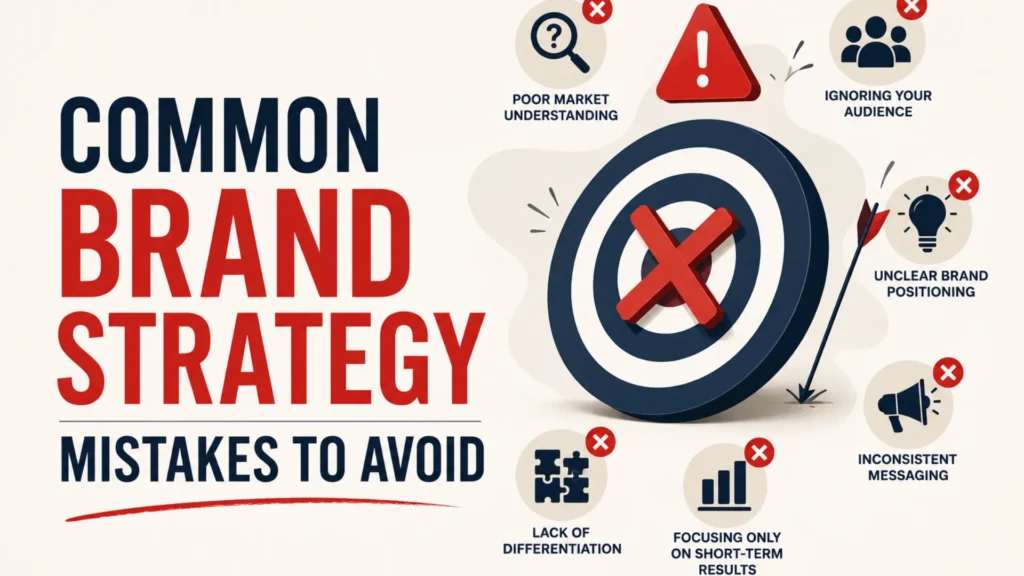
Even businesses with great products can struggle if they make the wrong branding decisions. A strong brand strategy should create trust, consistency, and long-term customer relationships. Avoiding these common mistakes can save time, reduce marketing costs, and strengthen your brand.
1. Trying to Target Everyone
When you try to appeal to everyone, your message becomes too broad. Focus on a specific audience that is most likely to benefit from your products or services.
2. Skipping Market Research
Making branding decisions without understanding customer needs or competitors often leads to poor positioning. Always base your strategy on research, not assumptions.
3. Having Inconsistent Brand Messaging
Different messages across your website, social media, and advertisements confuse customers. Keep your tone, values, and communication consistent across every platform.
4. Focusing Only on Visual Design
A logo and color palette are important, but they are only part of your brand. Your strategy should also define your purpose, positioning, messaging, and customer experience.
5. Copying Competitors
Successful brands learn from competitors but never imitate them. Build a unique identity based on your own strengths and value proposition.
Brand Strategy vs Branding vs Brand Identity: What’s the Difference?
Although these terms are often used interchangeably, they have different meanings. Understanding the difference helps businesses make better branding decisions.
| Brand Strategy | Branding | Brand Identity |
| A long-term plan for building and growing your brand. | The process of promoting and expressing your brand. | The visual and verbal elements that represent your brand. |
| Focuses on purpose, positioning, audience, and goals. | Focuses on communication and customer experience. | Includes logo, colors, typography, and design style. |
| Guides every business decision. | Brings the strategy to life. | Makes the brand recognizable. |
| Changes only when business goals change. | Evolves with marketing activities. | Can be refreshed while keeping the same strategy. |
In Simple Terms
- Brand Strategy decides why your brand exists and where it is going.
- Branding is how you communicate that strategy.
- Brand Identity is what people see and recognize.
Think of it like building a house:
- Brand Strategy is the blueprint.
- Branding is the construction process.
- Brand Identity is the finished appearance.
Without a strong strategy, even the best-looking brand identity may fail to connect with customers.
How to Measure the Success of Your Brand Strategy

Building a brand strategy is only the beginning. To understand whether it’s working, you need to measure its performance regularly. Tracking the right metrics helps you identify what’s working, where improvements are needed, and how your brand is growing over time.
Key performance indicators (KPIs) include:
- Brand Awareness: Measure how many people recognize your brand through surveys, search volume, or social media reach.
- Website Traffic: Monitor whether more people are visiting your website after branding efforts.
- Conversion Rate: Track how many visitors become customers.
- Customer Retention: A strong brand encourages repeat purchases and long-term Revenue Growth: Sustainable growth is one of the strongest indicators of an effective brand strategy.
These five KPIs provide a clear picture of how effectively your brand strategy supports customer engagement, business growth, and long-term success. Review performance regularly and refine your strategy based on customer feedback, market trends, and business objectives.
Real-World Brand Strategy Examples That Inspire Growth

A successful brand strategy is more than a marketing plan—it creates a lasting impression that influences how customers think, feel, and make purchasing decisions. Many of the world’s most recognized brands have achieved long-term success because they built a clear strategy before investing heavily in marketing. Here are some examples that demonstrate the power of strategic branding.
Apple – Simplicity and Innovation
Apple has built its brand around simplicity, premium quality, and innovation. Every product, advertisement, retail store, and customer interaction reflects the same values. Instead of competing on price, Apple focuses on delivering a seamless user experience that creates strong customer loyalty.
Key lesson: A clear brand strategy creates a consistent experience that customers trust and remember.
Nike – Inspiring Every Athlete
Nike’s brand strategy centers on motivation, performance, and personal achievement. Through powerful storytelling and emotional marketing, Nike connects with customers beyond its products, encouraging people to push their limits.
Key lesson: Customers often connect more with a brand’s purpose than its products.
Influence Nepal – A Local Example of Strategic Branding
In Nepal’s growing digital marketplace, many businesses invest in websites, advertising, or social media before defining their brand strategy. This often leads to inconsistent messaging and limited brand recognition.
Influence Nepal follows a strategic approach that begins with understanding the business, its target audience, competitors, and market opportunities. Instead of focusing only on design, the process includes market research, audience analysis, brand positioning, messaging, content strategy, SEO, and digital marketing execution. By aligning every customer touchpoint with a clear strategy, businesses can build stronger recognition, improve customer trust, and create sustainable long-term growth.
When and How to Choose a Brand Strategy Agency
While some businesses develop their brand internally, many benefit from professional guidance when launching, rebranding, expanding into new markets, or struggling with weak brand recognition. An experienced agency brings research, strategic thinking, and an objective perspective to help businesses build a stronger market position.
When choosing a brand strategy agency, look for:
- Proven branding experience
- Strong portfolio and case studies
- Research-driven strategy
- Industry knowledge
- Transparent communication
- Positive client reviews
- SEO and digital marketing expertise
The right agency should provide more than creative design—it should develop a strategy that supports long-term business growth.
Why Businesses Trust Influence Nepal for Brand Strategy Services

Building a strong brand requires more than creativity; it requires strategy, research, and a deep understanding of customer behavior. Influence Nepal helps businesses develop brand strategies that align with their goals, target audience, and competitive market.
The process begins with understanding each business, its industry, and its customers. Through market research, competitor analysis, audience insights, and strategic planning, the team develops a brand foundation that guides messaging, positioning, content, and digital marketing efforts.
Rather than offering one-size-fits-all solutions, every strategy is tailored to the unique needs of the business. By combining branding expertise with SEO, content marketing, website strategy, and digital marketing, businesses can create a consistent customer experience that supports long-term growth.
Whether you’re launching a startup, growing an established company, or refreshing your brand, a clear strategy can help you attract the right audience, build trust, and strengthen your competitive position.
Ready to build a stronger brand? Contact Influence Nepal for a personalized brand strategy consultation and discover how a research-driven approach can help your business grow with confidence.
Conclusion
A successful brand isn’t built through a logo alone, nor is it created by running occasional marketing campaigns. Strong brands are the result of consistent strategic decisions that shape how customers perceive, trust, and remember a business over time.
Businesses that invest in brand strategy before scaling their marketing efforts are generally better positioned to attract the right customers, improve conversion rates, and build long-term loyalty. Whether you’re launching a startup or strengthening an established company, a well-defined brand strategy provides the foundation for sustainable growth in an increasingly competitive marketplace.
If you’re looking for expert guidance, Influence Nepal can help you develop a research-driven brand strategy tailored to your business goals. Get in touch today to build a stronger, more recognizable brand that drives sustainable growth.
Frequently Asked Questions About Brand Strategy
1. What is a brand strategy?
A brand strategy is a long-term plan that defines how customers perceive, trust, and remember your business.
2. Why is a brand strategy important?
It helps businesses build trust, stand out from competitors, and create consistent customer experiences that support long-term growth.
3. What’s the difference between branding and brand strategy?
Brand strategy defines the direction of your brand, while branding is how that strategy is communicated visually and verbally.
4. Who needs a brand strategy?
Startups, SMEs, corporate companies, personal brands, educational institutions, NGOs, and e-commerce businesses can all benefit from a clear brand strategy..
5. How often should a brand strategy be updated?
Review it annually or whenever your business experiences major changes, such as expansion, rebranding, or entering new markets.
6. Should I hire a brand strategy agency?
If you’re launching, rebranding, expanding, or struggling with recognition and growth, professional guidance can help you build a stronger and more effective brand.